Best Post-Workout Meal: What to Actually Eat to Refuel and Recover
By:Author:Walking Yoga Editorial
Updated on:September 30, 2026
- Does a Post-Workout Meal Actually Work?
- Why This Beats the Harder Alternative
- The Quantity Question: How Much, How Often
- The Practical Question: What to Actually Eat
- Comparison: Whole Food Meal vs Quick Snack
- The Forbidden Promise, Answered Honestly
- Levers That Change the Result
- How Long Until You See Results?
- Your First Four Weeks
- What Stalls Progress
- Why Walking Yoga Works for This
- Final Thoughts
The best post-workout meal is simple: some protein, some carbohydrate, and enough of both to actually refuel you, eaten within a few hours of moving.
Muscles use up stored fuel during exercise and protein helps repair the tiny stresses placed on them. Eating something reasonable afterward just gives the body raw material to work with.
This guide covers what actually matters after a workout, how much food is worth eating, what stalls progress, and how gentle daily movement fits into all of it.
Does a Post-Workout Meal Actually Work?
Here's the mechanism in plain terms: exercise draws down stored carbohydrate and creates small amounts of muscle breakdown, and food supplies the glucose and amino acids needed to replace both.
A meal with roughly 20-30 grams of protein gives the body a solid dose of amino acids to work with. Pair that with a source of carbohydrate - rice, fruit, oats, bread - and stored energy gets topped back up.
The honest arithmetic: if a session burns a few hundred calories, no single meal undoes that. But it does support the repair process, and consistent meals like this, done most days, add up to a habit that supports the bigger goal.
None of this targets any one area of the body. Food and movement work on the whole system, not a specific spot.
Why This Beats the Harder Alternative
The harder alternative is treating every meal like a science project - weighing macros, timing things to the minute, stressing over a missed window.
That approach burns out fast. A simple post-workout meal that's easy to repeat beats a complicated one that gets skipped after a week.

Adherence is the real variable here. A plain plate of protein and carbs eaten four or five times a week does more for you than a perfect meal eaten once.
The goal isn't precision, it's repetition - the same low-effort choice, made often enough that it stops requiring willpower.
The Quantity Question: How Much, How Often
Most people do fine with one solid meal or substantial snack within a couple of hours of a workout, rather than obsessing over an exact minute.
Roughly 20-30 grams of protein plus a palm-to-fist sized portion of carbohydrate covers most bodies. Bigger frames or longer sessions can lean toward the higher end, smaller frames or shorter walks toward the lower end.
Find Your Own Number
Start with a portion that fits in one hand for protein and one cupped hand for carbs, then adjust based on hunger and energy over the following hour. If you're still starving an hour later, the portion was probably too small.
The table below gives a rough starting point by activity type - treat it as a first guess, not a rule.
| Activity Type | Protein Guide | Carb Guide |
|---|---|---|
Short walk or gentle flow | 15-20g | Small portion |
Longer walk or full session | 20-25g | Medium portion |
Strength work added in | 25-30g | Medium to large |
Very short session | 10-15g | Small portion |
The Practical Question: What to Actually Eat
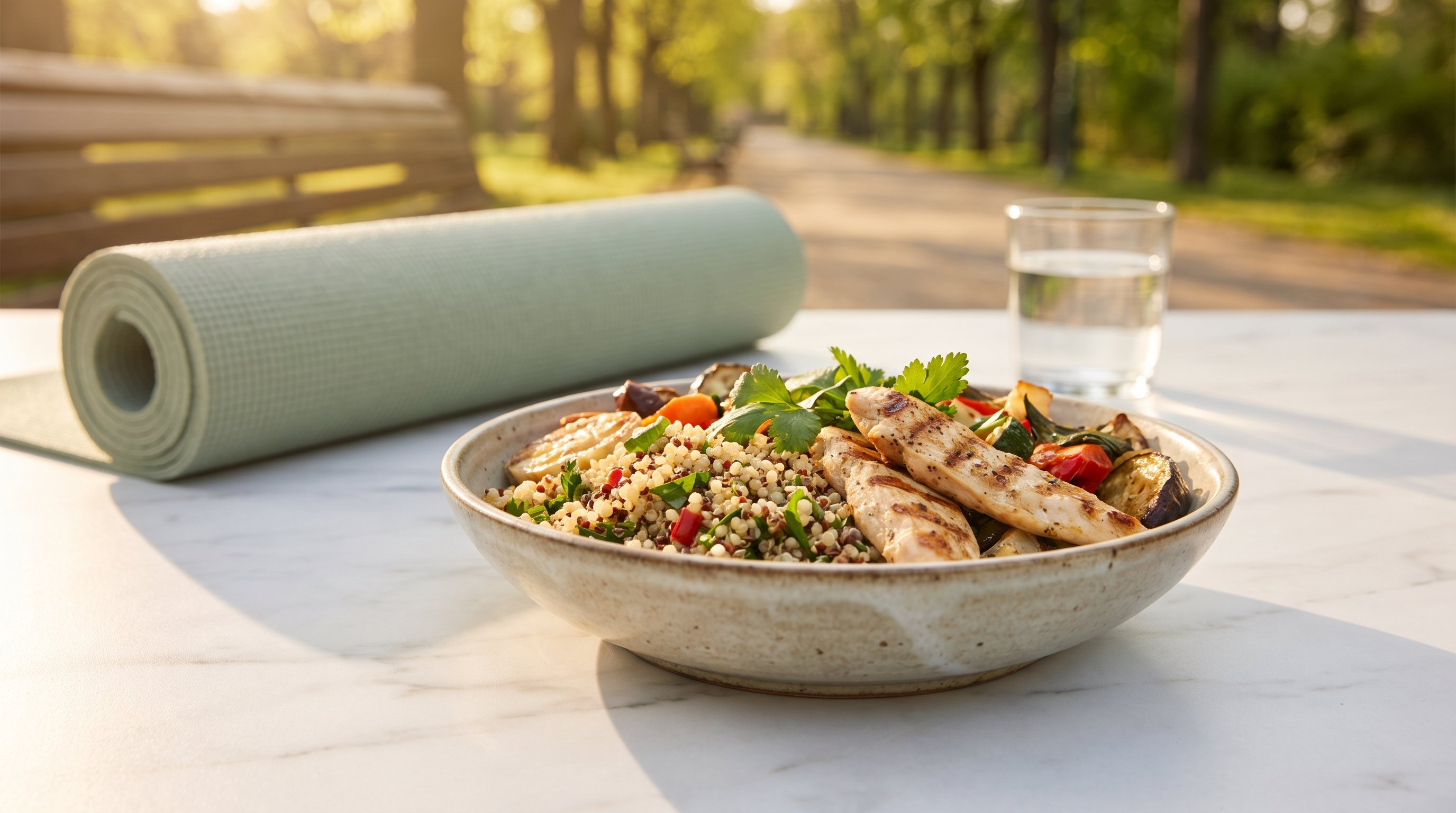
In practice, this means eggs and toast, a yoghurt with fruit, a chicken and rice bowl, or beans on toast - nothing exotic, just food that's already in the kitchen.
The easiest path is picking two or three go-to combos and rotating them, so the decision is made once and repeated many times over.
This is where a meal plan built around food you already like helps, because Walking Yoga pairs its gentle movement sessions with a personal meal plan so the food side of things isn't a separate project to figure out.
Keeping steps, water and weight in one place also makes it easier to see how movement and eating connect over a week, rather than judging things off one single day.
Comparison: Whole Food Meal vs Quick Snack
The real decision most people face isn't what's theoretically best, it's what's realistic on a busy day - a full meal or a fast snack.
| Option | Prep Time | Best For |
|---|---|---|
Whole food meal | 10-20 minutes | After longer sessions |
Yoghurt and fruit | 2 minutes | Busy mornings |
Egg and toast | 5-8 minutes | Quick refuel |
Leftovers from dinner | 1-2 minutes | No extra cooking |
Protein-rich smoothie | 3-5 minutes | On the move |
None of these is the single correct answer. The right one is whichever gets eaten, consistently, without adding stress to the day.
The Forbidden Promise, Answered Honestly
No post-workout meal targets fat in one area of the body, and no combination of foods works overnight.
The body doesn't choose where it draws energy from based on where you exercised or what you ate afterward - that's simply not how it works.
The real answer is steadier and less exciting: consistent movement, reasonable meals, and enough time for the pattern to build, spread across weeks and months rather than a single session.
Levers That Change the Result
A few factors matter more than the exact meal itself, in roughly this order of importance.
What Actually Moves the Needle
- How often you eat this way - one good meal a week barely registers, five or six a week starts to add up.
- Whether the movement itself is consistent - a post-workout meal only matters if there's a workout habit behind it to support.
- Sleep and stress levels - both affect appetite and recovery, and can undo good eating choices if they're consistently poor.
How Long Until You See Results?
This is where a lot of people quit - expecting a visible shift within days and giving up when it doesn't show.
Repair and adaptation happen gradually, and the honest answer is that it takes longer than most people hope, without a fixed date attached to it.
What's more useful than a countdown is tracking whether the habit itself is holding - are the meals happening, are the sessions happening, most weeks.
Your First Four Weeks
The order of focus matters more than hitting perfect numbers in week one.

| Week | Focus |
|---|---|
Week 1 | Pick two go-to meals |
Week 2 | Eat one within two hours |
Week 3 | Add a consistent snack option |
Week 4 | Notice energy and hunger patterns |
What Stalls Progress
Skipping Meals After a Session
Getting busy and forgetting to eat leaves the body without material to repair with. Keep something simple on hand, even a piece of fruit and a handful of nuts, so skipping isn't the default.
Overcomplicating the Plate
Trying to hit exact macro targets every time makes the habit feel like homework. A rough guess done consistently beats a precise plan done rarely.
Treating One Meal As the Whole Strategy
A great post-workout meal can't fix a week of poor sleep or no movement. Look at the whole week, not one plate.
Expecting Fast Visible Change
Giving up after a week or two because nothing looks different yet is one of the biggest reasons people stop. Judge the habit by whether it's still happening, not by the mirror.
Inconsistent Movement
A meal plan without a movement habit behind it loses most of its point. Keeping sessions regular, even short ones, gives the food something to support.
Why Walking Yoga Works for This
Walking Yoga was built around the idea that short, gentle sessions done often beat long sessions done rarely - the same logic that applies to post-workout eating.
The app pairs guided sessions with a personal meal plan created around food people already enjoy, plus trackers for steps, water and weight so the whole picture stays in one place.
Challenges built to support good habits and a mindfulness guide for stress mean the eating side and the movement side aren't treated as separate problems to solve.
Final Thoughts
The best post-workout meal isn't a secret formula - it's protein, carbohydrate, and enough consistency that it stops being a decision every time.
Pick two simple meals, eat them most days after moving, and let Walking Yoga handle the rest of the plan while the habit builds itself.
FAQ
There isn't one single best food - it's the combination that matters, some protein plus some carbohydrate. Eggs, yoghurt, chicken, beans and rice all work when paired sensibly.
The exact timing matters far less than people assume, and a meal within a few hours does the job fine. What matters more is that the meal happens at all, consistently.
Quick options like yoghurt with fruit or leftovers from the night before solve this without extra effort. Keeping two or three no-cook options on hand removes the barrier entirely.
One missed week doesn't undo progress, and picking the habit back up matters more than any single lapse. Walking Yoga's tracking makes it easy to see the pattern over weeks rather than judging off a bad day.
Share this post