Mindful Eating Tips: A Practical Guide That Actually Helps
By:Author:Walking Yoga Editorial
Updated on:October 28, 2026

- Steps to Build a Mindful Eating Habit
- How Often Mindful Eating Tips Actually Work
- Making Mindful Eating Work on an Ordinary Day
- A Four-Week Way Into Mindful Eating
- When the Shift in Eating Pace Shows Up
- Mistakes That Undercut Mindful Eating Tips
- Supporting Mindful Eating Tips With Walking Yoga
- Carrying Mindful Eating Into Tomorrow's Meals
Mindful eating means slowing down enough to notice what you're eating, how fast you're eating it, and when you've actually had enough. It's not a diet and it doesn't ban any food - it just puts attention back into a habit that often runs on autopilot.
The mechanism is simple. When you eat fast or distracted, your brain gets less signal time to register fullness, so you tend to keep going past the point where you'd otherwise stop.
This guide covers practical steps, how often to practise them, what a realistic starter plan looks like, and the mistakes that quietly undo the habit.
Steps to Build a Mindful Eating Habit
You don't need a retreat or a special room to start. A few small changes at the table are enough to shift how a meal actually feels.
Try These Steps at Your Next Meal
- Sit down properly - eating standing at a counter or over a sink makes it harder to register what's going in.
- Put utensils down between bites - this alone slows the pace without any extra effort.
- Remove one distraction - turn the phone face down or mute the screen during the meal, even just once a day.
- Notice the first few bites - texture, temperature, flavour - attention tends to fade fast after that, so use it early.
- Pause halfway through - ask whether you're still hungry or just finishing because the food is there.
- Name the fullness level - a rough scale from hungry to satisfied to overfull helps you catch the point to stop.
- Clear the plate before refilling - a short gap gives your body time to register what you've already eaten.
How Often Mindful Eating Tips Actually Work
One Meal a Day Is Enough to Start
You don't need to apply this to every meal straight away. Picking one meal a day to slow down and pay attention is enough to start noticing a difference in how full you feel.
Below is a simple way to apply the idea depending on which meal you've got the most control over.
| Meal | Approach | Focus |
|---|---|---|
| Breakfast | Sit down, no phone | First few bites |
| Lunch | Pause at halfway point | Hunger check |
| Dinner | Utensils down between bites | Pace |
| Snacks | Plate it, don't eat from packet | Portion awareness |
Making Mindful Eating Work on an Ordinary Day
Real days are busy, and most meals happen between tasks rather than in calm, quiet moments. The goal isn't to slow every single meal down - it's to find the one or two spots in your day where slowing down is realistic.
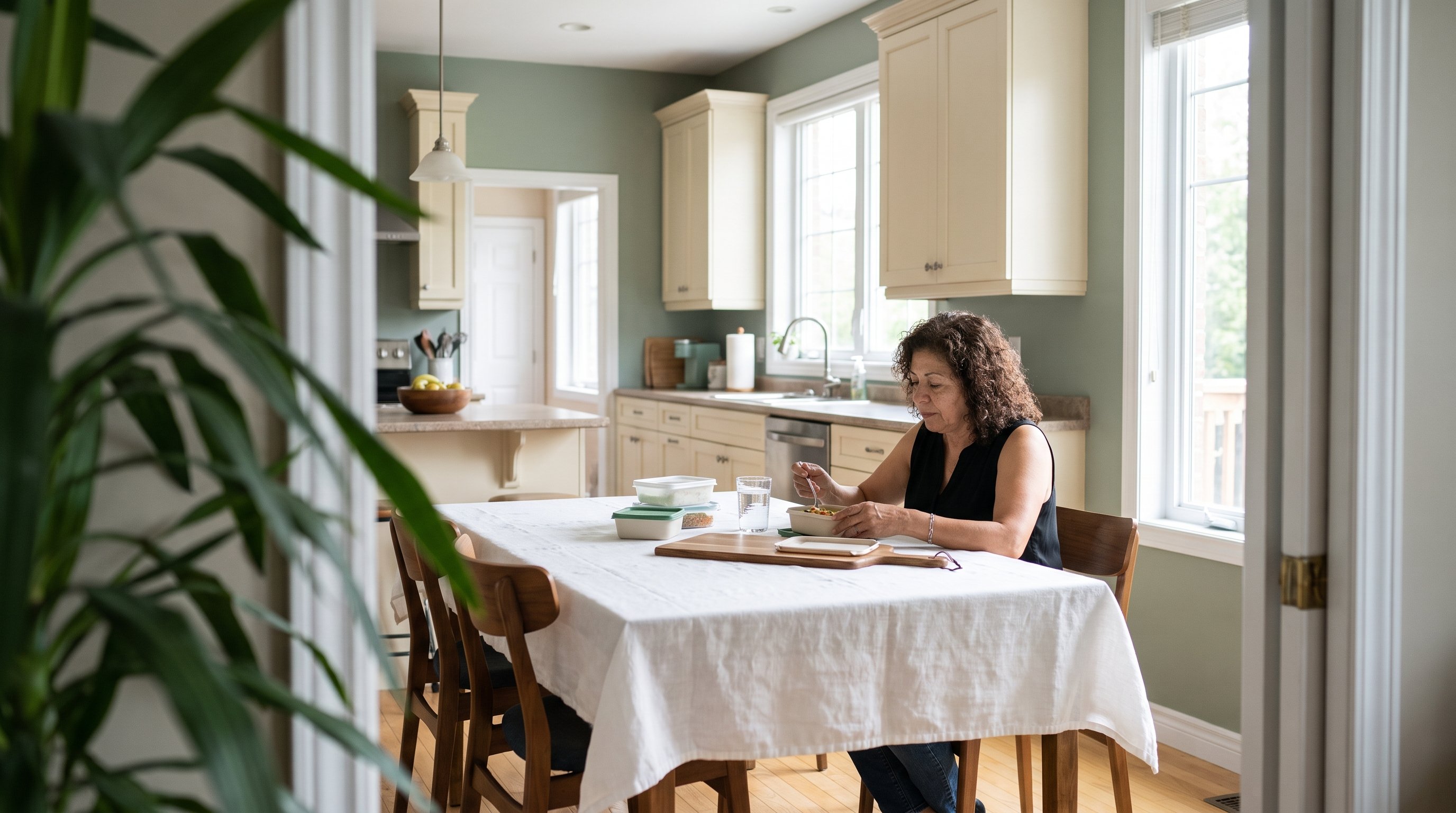
For some people that's breakfast before the day gets moving, for others it's the evening meal once work is done.
This pairs well with movement that already asks you to slow down and pay attention, which is part of what Walking Yoga builds around - gentle sessions paired with a meal plan built around food you already like, so the eating side doesn't feel like a separate project.
A Four-Week Way Into Mindful Eating
Building this habit works better in stages rather than trying to overhaul every meal at once. Here's one order that tends to stick.
| Stage | What To Add |
|---|---|
| Week 1 | Pick one meal, remove phone |
| Week 2 | Add utensils-down pause |
| Week 3 | Add halfway hunger check |
| Week 4 | Extend to a second meal |
When the Shift in Eating Pace Shows Up
There's no fixed week where mindful eating suddenly clicks - it tends to arrive gradually rather than all at once.
Early on, the pause-and-notice steps can feel clunky or forced, and that's normal rather than a sign it isn't working.
Most people find the habit starts to feel automatic once they've repeated it across enough meals that the slower pace stops needing conscious effort.
This is usually the point where people either quit, assuming nothing changed, or they keep going and the habit settles in on its own.
Mistakes That Undercut Mindful Eating Tips
Trying to Fix Every Meal at Once
Taking on breakfast, lunch and dinner all in the same week usually collapses within days. Pick one meal, get it steady, then add the next.
Treating It Like a Diet Rule
Mindful eating isn't about banning foods or counting anything - that turns it into another rigid plan to break. Keep the focus on pace and attention, not on what's allowed.

Skipping the Pause When Busy
The days you're rushing are exactly when the habit matters most, yet they're the days it gets dropped first. A single utensils-down pause takes seconds and still counts.
Expecting a Specific Result
Mindful eating changes how a meal feels, not a number on a scale by a set date. Judge it by whether meals feel calmer, not by any other measure.
Eating in Front of Screens by Default
If every meal happens next to a screen, there's no space left for noticing anything. Pick just one meal a day to eat without one.
Supporting Mindful Eating Tips With Walking Yoga
Slowing down at meals works best alongside a routine that already values pace over pressure, which is the whole idea behind Walking Yoga.
The app pairs an easy-to-follow personal meal plan with trackers for water intake and weight, so you can see how your eating habits line up with the rest of your day in one place.
There are also stress-relief techniques and guided meditations built in, which give you the same slowing-down skill you're using at the table but applied to the rest of your routine.

Walk Your Way Calm
Move Mindfully Daily
Carrying Mindful Eating Into Tomorrow's Meals
Pick one meal today and try just one step - phone away, utensils down between bites, or a pause at the halfway point.
Keep it small, repeat it, and let Walking Yoga handle the tracking side while you focus on the meal in front of you.
FAQ
It can support it indirectly, because eating slower gives your body more time to register fullness and that often means less food eaten before you feel satisfied. It's not a guaranteed figure or a fixed timeframe, just a shift in how meals feel.
No - there are no banned foods and no counting involved, it's purely about pace and attention. You can apply it to any meal, including ones you'd never put on a diet plan.
Start with whichever single meal gives you the most control, even if that's only one day a week. A short pause before the first bite still counts, even standing at a desk.
Trying to apply it to every meal at once is the most common reason it falls away, since it feels like too much to manage. Using Walking Yoga's meal plan and trackers alongside it can take some of that pressure off by keeping the rest of your routine organised.
Share this post