Walking Workout At Home: A Practical Beginner's Guide
By:Author:Walking Yoga Editorial
Updated on:September 29, 2026
- Does a Walking Workout at Home Actually Work?
- Why This Beats the Harder Alternative
- The Quantity Question: How Much Walking Do You Actually Need?
- The Practical Question: How Do You Actually Fit It In?
- Walking for Beginners: What's Useful, What's Arbitrary
- Indoor Walking vs Other Options
- The Forbidden Promise, Answered Honestly
- Levers That Change the Result
- How Long Until You See Results?
- Your First Four Weeks
- What Stalls Progress
- Why Walking Yoga Works for This
- Final Thoughts
- Frequently Asked Questions
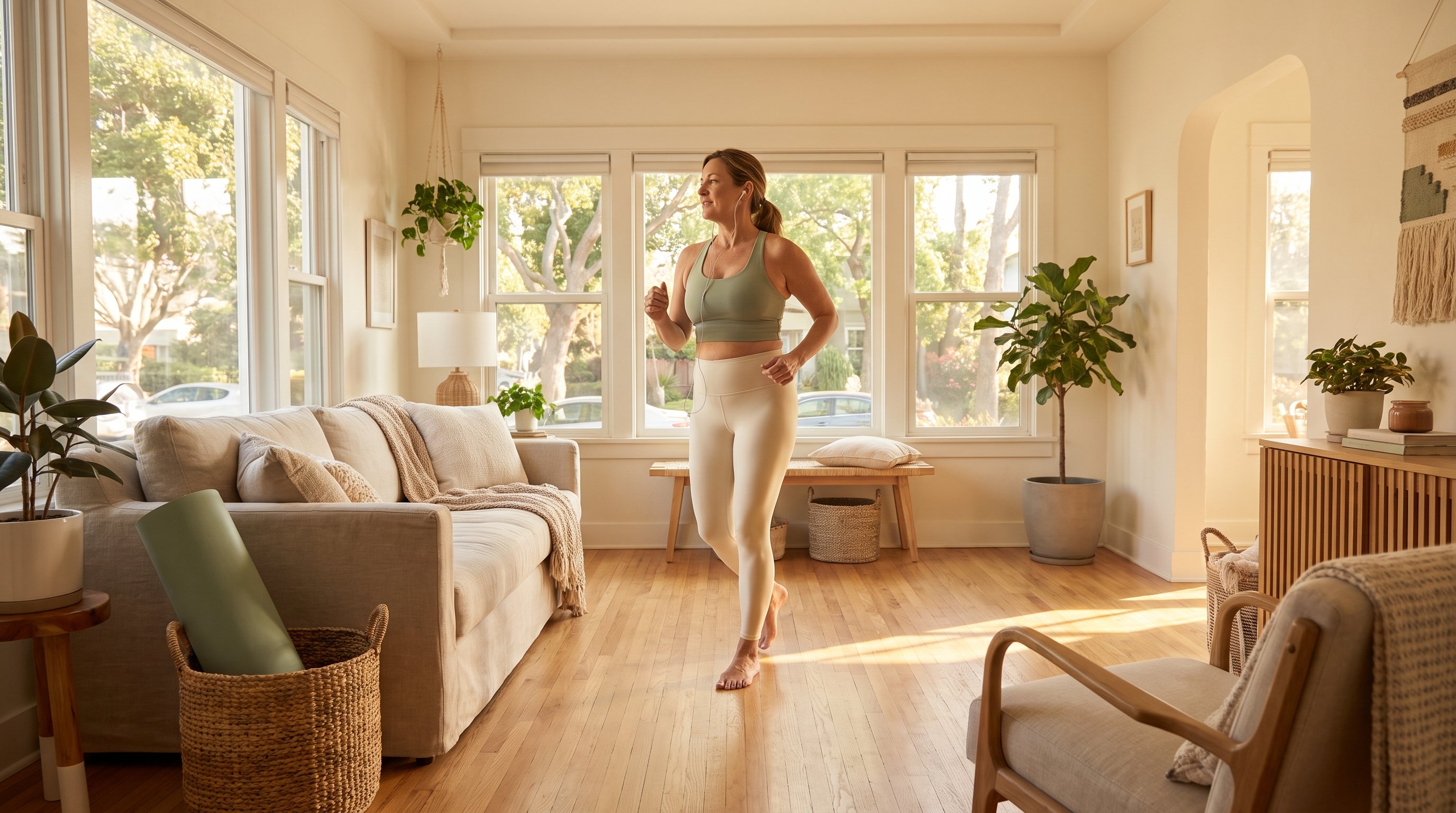
A walking workout at home can fit into a normal day without needing a gym, a treadmill, or even much space - 15 minutes in a living room counts.
Walking works because it's movement your body already knows how to do well, so there's no learning curve slowing you down and no injury risk keeping you on the sidelines.
This guide covers whether indoor walking actually does anything, how much you need, what a first month looks like, and what tends to derail people before they get anywhere.
Does a Walking Workout at Home Actually Work?
Walking burns energy because it moves your whole body weight against gravity, over and over, for as long as you keep going.
The honest arithmetic: a 15-minute session done most days adds up to well over an hour of movement across a week, and that's before you count the incidental steps you already take.
None of that changes overnight, and nothing about walking targets a specific body part - it simply adds consistent movement to your week, which is the part that actually compounds.
Why This Beats the Harder Alternative
A brutal workout you do twice and quit does less for you than a gentle one you repeat forty times.
Adherence is the whole game - the number of sessions completed in a month matters more than how hard any single one of them felt.
Indoor walking removes almost every excuse: no commute, no weather, no equipment to find, so the barrier between you and session one is close to zero.
That's not a small thing - it's the difference between a routine that survives a busy week and one that doesn't.
The Quantity Question: How Much Walking Do You Actually Need?
There's no single right number, but there is a useful starting point: something short enough to finish, done often enough to matter.
Fifteen minutes a day is a realistic floor for most people, because it fits before work, during a lunch break, or in front of the television in the evening.
Find Your Own Number
Start with whatever you can do five days out of seven without dreading it - that number matters more than any figure in an article.
Once that's comfortable, you can add a minute or two, or add a second short session later in the day, rather than jumping straight to something longer than you can sustain.
| Goal | Session Length | Frequency |
|---|---|---|
Just getting moving | 10-15 minutes | Most days |
Building a habit | 15-20 minutes | 5-6 days a week |
Steady progress | 20-30 minutes | Daily |
The Practical Question: How Do You Actually Fit It In?
Knowing you should walk more and actually doing it are two different problems, and the gap between them is usually planning, not motivation.
The easiest fix is picking a fixed slot - the same 15 minutes, the same time, the same spot in the flat - so it stops needing a decision every day.
Walking Yoga structures that slot for you with guided sessions and a plan built around your pace, plus trackers for steps, water and weight so you can see the pattern building without guessing.
Having the plan already made removes the one decision most likely to talk you out of it on a tired evening.
Walking for Beginners: What's Useful, What's Arbitrary
You'll see fixed step counts and named routines floating around, and it's worth knowing which parts of them are genuinely useful and which are just tidy numbers.
The useful part of any plan is the repetition - the same movement, most days, long enough to become automatic.
The arbitrary part is the exact number attached to it - there's nothing special about a round figure, it just happens to be easy to remember and market.
Treat any named target as a rough guide, not a rule, and adjust it to whatever you can actually repeat this week.
Indoor Walking vs Other Options
Most people choosing to walk at home are really weighing it against a gym membership, running, or doing nothing at all.
Here's how the practical side of each stacks up.
| Option | Cost | Barrier To Start | Joint Impact |
|---|---|---|---|
Walking at home | No equipment needed | Very low | Gentle |
Gym membership | Monthly fee | Travel and time | Depends on activity |
Outdoor running | Shoes only | Weather dependent | Higher impact |
Home cardio equipment | Upfront purchase | Needs space | Varies |
No structured movement | None | None | No progress either |
The Forbidden Promise, Answered Honestly
No walking routine, at home or anywhere else, burns energy from one specific area of the body - that's not how the body works, and any plan promising it is wrong.
There's also no overnight version of this - a session or two changes nothing you can see in a mirror.
What walking does do is add movement to your week, consistently, which is the honest and unglamorous mechanism behind every real result anyone gets from it.
That's the whole promise, and it's a decent one - just not a fast or targeted one.
Levers That Change the Result
Three things move the needle more than any workout tweak, and they're worth getting right in order.
What Actually Moves the Needle
- Sessions completed per month - showing up fifteen times beats one hard session, because the total adds up while a skipped week erases progress.
- What you eat around it - movement alone is slow to change much without a food plan that fits how you actually eat.
- Sleep and stress - a body under constant stress holds onto tension that makes every other habit harder to keep.
How Long Until You See Results?
This is where most people quit - somewhere between week two and week four, right when it feels like nothing is happening yet.
Movement habits tend to show up first as easier sessions and better sleep, long before anything visible changes, so those early signs are worth paying attention to.
There's no fixed timeline that applies to everyone, and anyone promising one is guessing - what matters is whether the sessions are still happening a month from now.
Your First Four Weeks
The order of these weeks matters more than the exact minutes attached to them.
| Week | Focus | Target |
|---|---|---|
Week 1 | Show up daily | 10-15 minutes, any pace |
Week 2 | Find your slot | Same time, same place |
Week 3 | Add a little | 15-20 minutes |
Week 4 | Check the pattern | Review steps and consistency |
What Stalls Progress
Starting Too Big
Jumping straight to 45 minutes a day is a great way to quit by day four - a smaller session you'll actually repeat beats an ambitious one you won't.
No Fixed Time
If the session floats around looking for a free moment, it usually loses to whatever else is happening that day - fix a slot and protect it.
Ignoring Food Entirely
Movement without any change to what you're eating is slow going - a simple meal plan built around food you already like closes that gap.
No Way to See Progress
Without tracking steps, water or weight somewhere, weeks blur together and it's easy to assume nothing's happening even when it is.
Treating One Missed Day As Failure
One skipped session is nothing - the habit only actually breaks if you let one missed day turn into a week.
Why Walking Yoga Works for This
A walking workout at home only works if you keep doing it, and that's exactly the problem Walking Yoga is built to solve.
It pairs guided sessions with a customized plan for weight loss, a meal plan built around food you already like, and trackers for steps, water and weight so the pattern is visible instead of guessed at.
There are also stress-relief techniques, more than 100 guided meditations, and challenges built to turn a shaky new habit into a routine you actually stick with.
Final Thoughts
A walking workout at home is about as low-barrier as fitness gets - no equipment, no commute, no learning curve, just fifteen minutes and a bit of floor space.
Pick a time, protect it, and let Walking Yoga handle the planning and tracking while you focus on just showing up.
Frequently Asked Questions
Can Walking at Home Actually Help With Weight Loss?
Walking adds consistent movement to your week, and combined with a change to what you eat, that consistency is what tends to matter over time. It's not a fast fix, and there's no figure worth attaching to a timeframe, but it's a real mechanism, not a gimmick.
Isn't Walking Too Gentle to Count As a Real Workout?
Gentle doesn't mean ineffective - it means you can repeat it tomorrow, and the day after, which is exactly what harder workouts often fail at. A session you finish beats one you dread and skip.
What If There's No Space for a Proper Walking Route Indoors?
You don't need a route - pacing a room, walking on the spot, or a short loop through a hallway all count. The movement matters more than the distance covered.
What Usually Happens Around Week Three When Motivation Dips?
That's the point where most people quit, right before the habit would have started feeling automatic. Walking Yoga's short guided sessions and progress tracking are built to get you past exactly that stretch.
Share this post