How Much Water Should I Drink? Practical Ways to Hit Your Daily Target
By:Author:Walking Yoga Editorial
Updated on:September 30, 2026
- Does Drinking Enough Water Actually Work?
- Why This Beats the Harder Alternative
- The Quantity Question: How Much Water Should You Drink
- The Practical Question: How Do You Actually Hit That Number
- Comparison: Plain Water Versus Other Ways to Hydrate
- The Forbidden Promise, Answered Honestly
- Levers That Change the Result
- How Long Until You See Results?
- Your First Four Weeks
- What Stalls Progress
- Why Walking Yoga Works for This
- Final Thoughts
A common starting point is about 2 litres a day for most adults, roughly eight glasses, though body size, activity and climate all shift that number up or down.
Water moves nutrients, keeps joints lubricated and helps the body regulate temperature, so even a small shortfall can leave you feeling flatter than usual during a walk or a stretch.
This guide covers what a sensible daily target looks like, how to build the habit without obsessing over it, and how tracking water alongside movement makes the whole thing easier to stick with.
Does Drinking Enough Water Actually Work?
The mechanism is simple. Water is the medium your body uses to transport blood, cushion joints and cool itself down through sweat.
Run short on fluid and blood volume drops slightly, which means the heart works a little harder to deliver the same amount of oxygen during a walk or gentle flow.
Here's the honest arithmetic: if you weigh 70 kg and lose 1kg of sweat during a session, that is roughly 1 litre of fluid to replace before you top up for the rest of the day.
Skip that and you might notice heavier legs or a duller focus by the next session, not because the workout failed but because the fuel tank was low.
Why This Beats the Harder Alternative
Some people try to fix hydration with rigid rules: a specific number of litres, timed to the minute, tracked to the millilitre.
That approach is hard to sustain, and hard-to-sustain habits get dropped within a week or two.
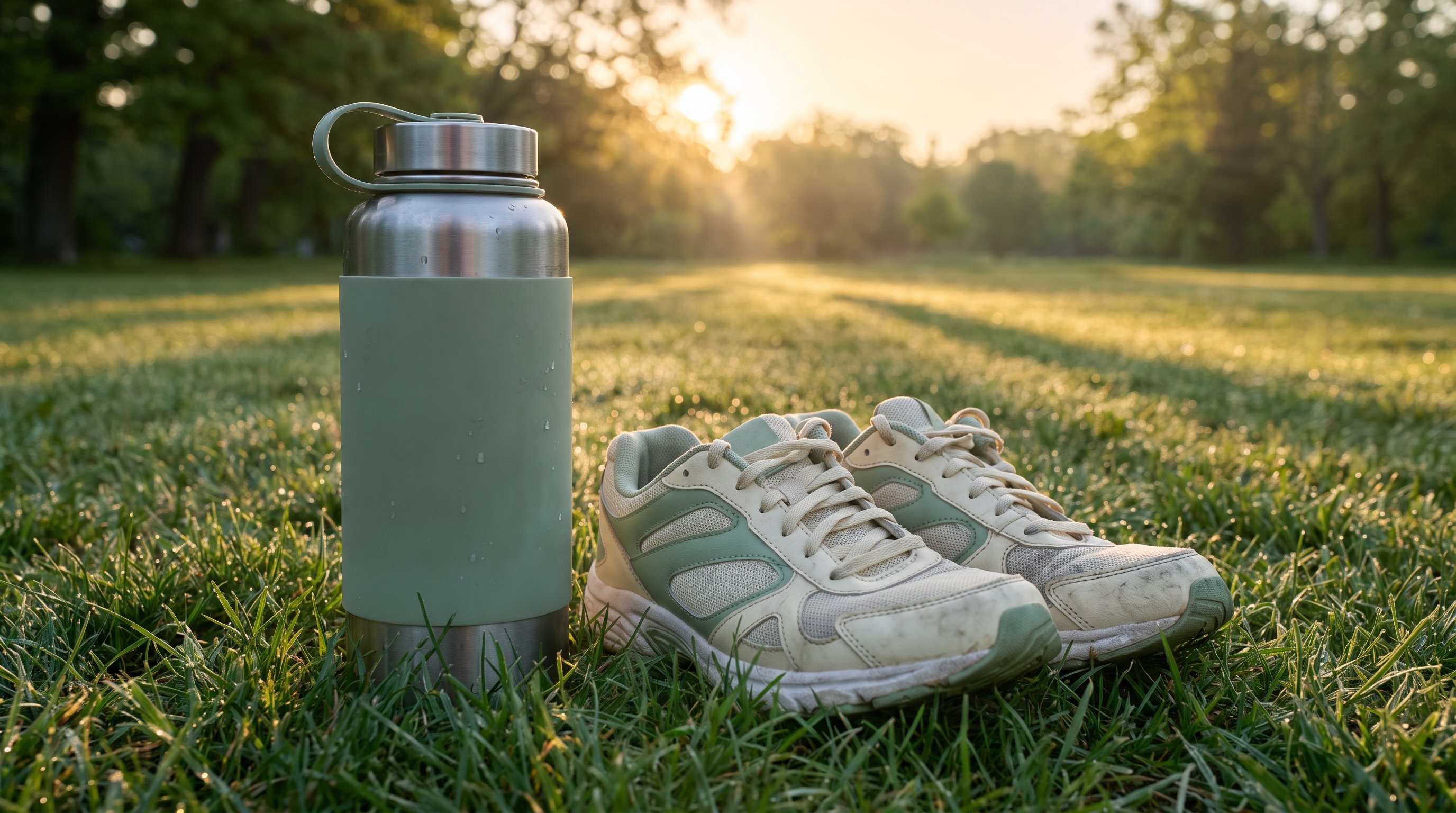
A softer version - sipping steadily through the day, refilling a bottle a set number of times - is easier to repeat, and repeating it is what actually matters.
Adherence beats precision here. A rough target you hit most days will always outperform a perfect target you hit twice a month.
The Quantity Question: How Much Water Should You Drink
The often-quoted figure is about 2 litres, or eight 250 mL glasses, spread across the day rather than gulped in one sitting.
Add movement and that number climbs a little - a 15-minute walking session in warm weather can mean an extra 250 to 500 mL to replace what you sweat out.
Find Your Own Number
Body weight is a rough guide: a common rule of thumb is around 30 to 35 mL per kg of body weight per day, which puts a 60 kg person near 1.8 to 2.1 litres and an 85 kg person nearer 2.5 to 3 litres.
Use that as a starting range, then adjust for heat, activity and how thirsty you actually feel.
| Your Situation | Rough Daily Target |
|---|---|
Light activity, cool day | 1.8 to 2 litres |
Daily 15-minute walk | 2 to 2.3 litres |
Warm climate, active day | 2.3 to 2.8 litres |
Larger body frame | 2.5 to 3 litres |
Smaller body frame | 1.8 to 2.2 litres |
The Practical Question: How Do You Actually Hit That Number
Knowing the target is one thing. Remembering to drink through a busy morning is another.
A bottle kept in sight, a glass with every meal, and a top-up before and after a walk cover most of the day without much thought.
Keeping steps, water and weight in one place makes the pattern visible, which is exactly what the water tracker inside Walking Yoga is built for - it sits alongside the step counter so hydration stops being an afterthought.
Seeing the numbers side by side, most days, is what turns a vague intention into an actual habit.
Comparison: Plain Water Versus Other Ways to Hydrate
Water is not the only source of fluid, and the reader weighing options usually wants to know what actually counts toward the day's total.
| Fluid Source | What To Know |
|---|---|
Plain tap or bottled water | Counts fully, zero calories |
Herbal tea | Counts fully, mostly water |
Fruit and vegetables | Contributes some fluid content |
Coffee or caffeinated tea | Counts, mild diuretic effect |
Sugary soft drinks | Hydrates, adds extra sugar |
Plain water stays the simplest default because it needs no second thought and adds nothing you have to account for later.
The Forbidden Promise, Answered Honestly
Water will not target one area of the body, and no amount of it burns fat from a specific spot.
The body does not choose where it stores or releases energy based on where you focus your attention, and no drink changes that.
What water does do is support the systems that let you move well and feel steady, which is a quieter benefit but a real one.
Pair steady hydration with regular movement and a sensible eating pattern, and the results come from that combination, not from the glass alone.
Levers That Change the Result
Three factors matter more than the exact litre count, and they are worth getting right before you fuss over the last 100 mL.
What Moves the Needle
- Spreading intake across the day - sipping steadily beats one large glass at bedtime, since the body absorbs a steady drip more evenly than a flood.
- Matching intake to activity - a walking session or warm day calls for a top-up, so build that into the same routine as the workout itself.
- Consistency over precision - hitting a rough target most days beats hitting an exact number occasionally, because the habit is what compounds.
How Long Until You See Results?
Some effects of steady hydration show up fast - clearer focus, less midday sluggishness - while others, like how your joints feel during movement, take longer to notice.
This is usually where people give up, expecting a dramatic shift and finding a quiet one instead.
Stay vague about the exact week and focus on the pattern: most people who keep the habit going report it becomes automatic well before it becomes something they think about.
Give it time to become boring. Boring is usually the sign it has become a habit.
Your First Four Weeks
The order you build habits in matters more than hitting a perfect number from day one.
| Week | What To Build |
|---|---|
Week 1 | Keep a bottle visible all day |
Week 2 | Add a glass with each meal |
Week 3 | Top up before and after walks |
Week 4 | Track intake to spot patterns |
What Stalls Progress
Forgetting Until You're Already Thirsty
Thirst is a lagging signal, so waiting for it means you are already behind. Set a couple of fixed check-in points, like with breakfast and after a walk, instead of relying on the urge.
Treating Every Drink the Same
Sugary drinks hydrate but add extra intake you have to account for elsewhere. Lean on plain water or herbal tea as the default and treat the rest as extras.
Chasing an Exact Number
Obsessing over an exact millilitre count turns a simple habit into a chore. A rough range hit most days beats a precise target hit rarely.
Ignoring Activity Days
A walking or movement session raises the target for that day, and skipping the top-up leaves you running on empty. Build the extra glass into the same routine as the session itself.
No Visible Tracking
What isn't tracked is easy to forget by mid-afternoon. A simple log, even a rough one, keeps the habit in view.
Why Walking Yoga Works for This
Hydration sticks best when it sits next to the other habits you are already building, not as a separate task to remember.
Walking Yoga keeps a water tracker alongside step counts, weight and fasting logs, so a glass after a 15-minute session becomes part of the same routine instead of an extra chore, and the guided sessions and challenges give you a reason to open the app daily, which is when the tracking habit actually forms.
Final Thoughts
There is no single perfect number for how much water to drink, only a sensible range that shifts with your body, your activity and the weather.
Start with a rough target, adjust it around your walks, and let a tool like Walking Yoga keep the habit visible until it stops needing your attention at all.
FAQ
A common starting range is about 2 litres, or roughly eight 250 mL glasses, adjusted up for body size, activity and heat. Use body weight as a rough guide, around 30 to 35 mL per kg, then fine-tune from there.
It does not need to be. A rough daily range you hit most days works better than a precise figure you chase and abandon.
Fixed check-in points, like a glass with each meal and a top-up around your walk, remove the need to rely on memory or thirst. Keeping a bottle visible on the desk or counter helps more than any reminder.
Most people stop because the habit feels invisible with no clear payoff day to day. Logging water inside Walking Yoga alongside steps and weight keeps the pattern visible, which is often enough to keep it going.
Share this post